Discover how Ivy League universities create global leaders through academic excellence, research, and global exposure. Learn what defines top universities.
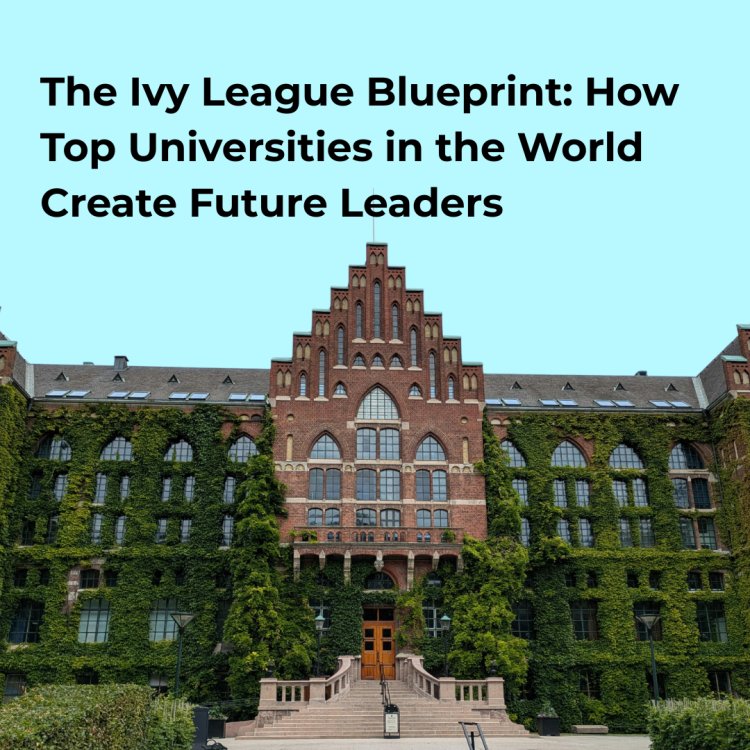
Every year, global rankings feature familiar names among the top universities in the world. The Ivy League comprises eight prestigious institutions: Harvard University, Yale University, Princeton University, Columbia University, University of Pennsylvania, Brown University, Dartmouth College, and Cornell University. These universities consistently remain near the top —not just because of reputation, but because they have mastered something deeper: the ability to turn ambitious students into innovators, researchers, and global leaders.
The real question, therefore, is not simply why these universities are prestigious.
It is how they repeatedly create individuals who go on to shape industries, technology, and public policy around the world.
For many international students pursuing global education, universities within the Ivy League represent the pinnacle of academic aspiration. Yet their success is not built on prestige alone. Behind the global reputation lies a carefully developed ecosystem of academic rigor, interdisciplinary learning, international diversity, and a strong research culture.
Understanding this blueprint offers valuable insight into what truly defines the best universities in the world.
Academic Excellence at Best Universities in the World
Ivy League universities consistently appear in the global ranking of universities. However, their reputation rests on more than rankings—it is rooted in a culture that prioritizes intellectual curiosity and rigorous scholarship.
Students enrolled in undergraduate courses, and postgraduate courses are encouraged to move beyond traditional disciplinary boundaries. For example, a student pursuing engineering might also study economics, public policy, or philosophy.
This interdisciplinary approach reflects an important reality: the most complex global challenges rarely belong to a single academic field. By encouraging students to explore diverse subjects, universities cultivate deeper analytical thinking and sustained academic achievement.
Global Education and the Rise of International Students
Another defining strength of elite universities is the diversity of their student communities. Campuses bring together students from across continents, creating environments where cultural and intellectual exchange become part of everyday learning.
At institutions such as Harvard University and Columbia University, international students represent a significant portion of the campus population. According to the Institute of International Education, international students accounted for nearly 6% of total higher-education enrollment in the United States in recent years.
This diversity shapes a dynamic student life experience. Students collaborate on research, participate in global forums, and attend cultural events that expose them to different perspectives and ideas.
These interactions help develop cross-cultural understanding and communication skills—qualities increasingly essential in a globally connected workforce.
From Classroom Learning to Real-World Career Opportunities
Elite universities also distinguish themselves through their emphasis on applying knowledge beyond the classroom.
Students are encouraged to participate in research projects, internships, and innovation initiatives. At Princeton University, for instance, undergraduate students frequently collaborate with faculty on research in areas such as artificial intelligence, environmental science, and public policy.
These opportunities allow students to gain practical experience early in their academic journey. For those studying engineering courses or other technical disciplines, participation in research labs and startup incubators can translate directly into valuable professional experience and strong university career opportunities.
By integrating academic learning with real-world application, these universities prepare graduates for emerging industries and jobs for the future.
College Scholarships and Access to Global Universities
Despite their reputation for high costs, many elite universities are committed to expanding access to higher education.
Through college scholarships, global scholarships, and international student scholarships, these institutions support talented students from a wide range of economic backgrounds.
Students drawn to finance and accounting will find strong options well beyond the US — [Best Countries to Study Finance & Accounting Abroad]."
These financial aid initiatives ensure that students with strong academic potential can pursue opportunities at some of the top universities in the world, regardless of financial circumstances.
Study Abroad Opportunities Beyond Ivy League Universities
While Ivy League universities remain iconic, they represent only a small portion of the global higher-education ecosystem.
Today, students can pursue high-quality education at leading public universities, research-focused state universities, and innovative government universities across many countries.
There are various other universities that support the other trending and in demand fields, for example, students who want to pursue an MBA degree, UK is the best option, the UK in particular has become a leading destination. Check out ACHIVIA’s insights - [MBA in the UK: Where Global Leadership Begins Before the Job Title Exists].
Similarly, universities in Germany are widely recognized for engineering and research programs. Many students also choose to learn the German language, which can open additional academic and professional opportunities across Europe.
This broader landscape shows that exceptional learning environments can be found across many institutions worldwide.
The Blueprint Behind Top Ranked Universities Worldwide
The success of Ivy League institutions ultimately comes from the way multiple elements work together. Rigorous academics, interdisciplinary learning, diverse student communities, and strong research opportunities combine to create environments where curiosity thrives. Students benefit from mentorship networks, career development resources, and scholarship programs that help translate academic knowledge into real-world impact.
These factors explain why graduates from such universities often move into leadership roles across business, science, government, and technology.
Choosing the Right University for Your Global Education Journey
The story of institutions like Harvard University and Princeton University illustrates an important lesson: great universities do more than deliver lectures—they create ecosystems where ideas are challenged, discoveries are made, and leadership is cultivated.
For students considering global education, the most important decision is not simply choosing a prestigious name. It is choosing an environment that encourages intellectual exploration, global collaboration, and meaningful engagement with real-world challenges.
When students find universities that foster these qualities, education becomes more than preparation for a career—it becomes preparation for shaping the future.
What's Your Reaction?